
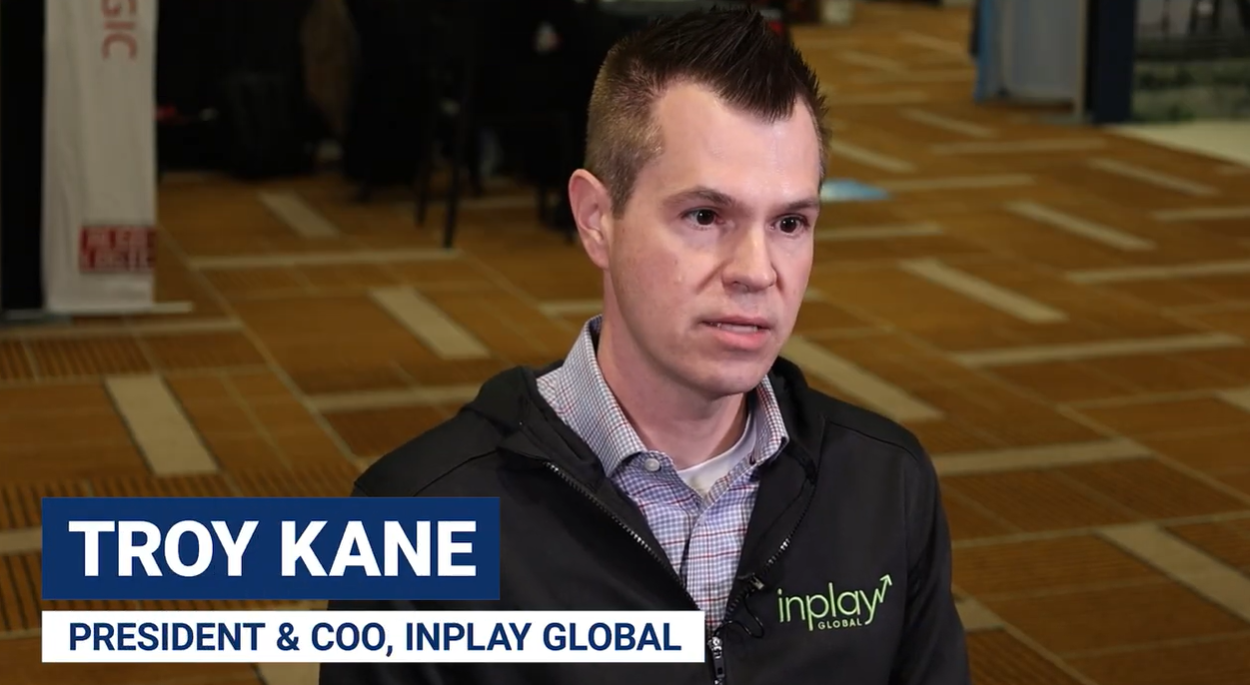
CHICAGO, IL (JLN) — December 23, 2025 — Inplay Global is preparing to launch the first-ever securities exchange dedicated to sports performance, pioneering a new asset class regulated under the U.S. Securities and Exchange Commission (SEC), according to company President and COO Troy Kane. Speaking at the FIA EXPO held at the Sheraton Grand Riverwalk Hotel, Kane detailed how Inplay Global […]
CHICAGO, IL (JLN) — December 23, 2025 — Inplay Global is preparing to launch the first-ever securities exchange dedicated to sports performance, pioneering a new asset class regulated under the U.S. Securities and Exchange Commission (SEC), according to company President and COO Troy Kane.
Speaking at the FIA EXPO held at the Sheraton Grand Riverwalk Hotel, Kane detailed how Inplay Global plans to securitize the performance of individual sports teams, beginning with the NFL. The model creates individual C Corp companies—such as “InPlay Chicago Bears Inc.”—that track team success over an entire season, allowing investors to trade in and out of the securities long-term, rather than focusing on single games or events.
The core economic engine of the security is tied directly to on-field wins: for every victory an NFL team achieves throughout the season, InPlay will pay shareholders $5 per share. Initial public offerings (IPOs) will be priced based on projected season wins; for example, if the Chicago Bears are projected to win eight games, the initial offering price would start at $40 per share.
Inplay Global is bringing these C Corp companies public through a Reg A, Tier 2 offering, which permits raising up to $75 million per company per issuance. Kane explained that the choice of an equity framework under the SEC, rather than a CFTC-regulated prediction market model, was deliberate, facilitating “more long-term type investing.” He noted that equities are far more understood by the general public than derivatives or prediction markets, making the access model less prohibitive. Inplay is launching as an Alternative Trading System (ATS) and is anticipating full regulatory approvals in the first quarter of 2026.
Beyond team wins, a secondary revenue attribution model relies on weekly investor engagement, measuring order flow, trades, and participation. At the end of a sporting event, teams will receive an allocation based on the proportion of investor engagement they received.
This means that even if a team loses a match, like the Minnesota Vikings in a hypothetical scenario, they could still accrue revenue if their securities generated high investor interest and trading volume that week. This engagement measurement includes shorting the team, as that still signifies interest and trading activity in the team company.
Kane stressed that the securities fill a significant gap in the financial landscape, acting as a “true risk management vehicle for sports trading or sports performance.” He noted that almost every other asset class has a risk management tool—whether insurance or derivatives—but sports performance lacks one. The securities could be used by organizations whose revenues depend on team success, such as a garage owner who relies on game attendance, to offset potential financial risk.
Inplay Global’s rollout plan includes an initial launch in the spring focused on the NBA playoffs, followed by the World Cup next summer, which the company sees as its “premier event.” After that, they plan to list securities for NFL football and Division 1 college football starting in the fall. The firm intends to conduct two issuances each season—one for regular play and another for playoffs or tournaments.
Notably, the securities do not require affiliation with or approval from any individual sports team, as Inplay relies on the fair use doctrine to create financial instruments based on publicly available information.
Kane also indicated that the company views the launch as a significant opportunity to enhance financial literacy. Inplay plans to launch its own app and website, including videos and webinars, to educate investors on concepts such as primary versus secondary markets, how stocks are created and valued, and the overall process of a company becoming public.